
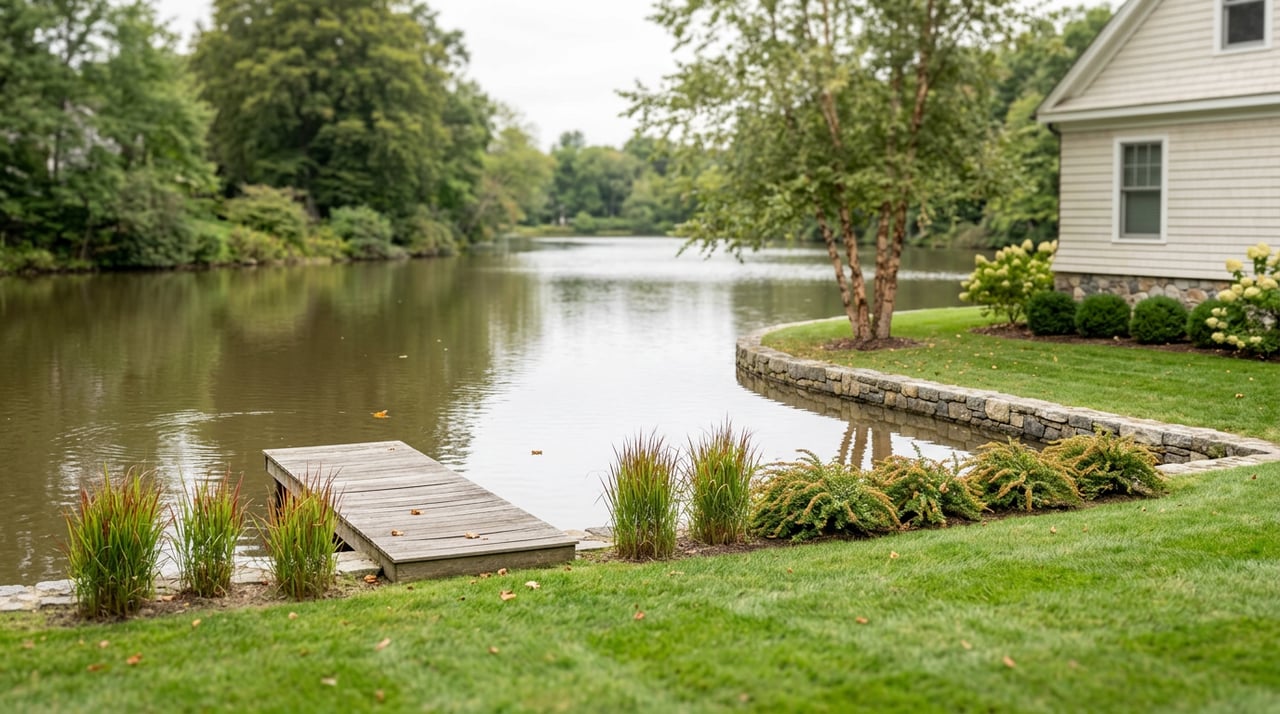
Drive along Carlough Road in Upper Saddle River and you will not see the lake. A ring of homes on generous, tree-shaded lots keeps it tucked from the street, visible only in flashes between driveways and hedgerows. Most people who pass assume it has always belonged to the houses around it, a private amenity built the way private amenities usually get built here, quietly and by design.
That is not what happened. Anona Lake was public before it was private, and for nearly forty years it was one of the busiest weekend destinations in this part of Bergen County, drawing families out from the crowded blocks of Jersey City and Hoboken for a day by the water. The residential quiet that now defines this stretch of the borough sits directly on top of a much noisier, more commercial past, and Anona is not even the only example. Upper Saddle River is dotted with the remains of a vanished leisure economy, ponds and pavilions that once charged admission and now show up on tax rolls as ordinary backyards.
A Dammed River and a Business Plan
The lake exists because William H. Yeomans decided it should. In 1924 he began buying up land along the Saddle River and dammed it to create the pond that still bears the Anona name. He built a refreshment stand and bathhouses first, then added a large pavilion within a year or two. This was not a private retreat for Yeomans and his neighbors. It was Anona Park, a commercial swimming resort that opened to the paying public in 1928 and stayed open, through a change of ownership, until 1967.
The Historical Society's own archive of the borough's disappeared landmarks describes it plainly: Anona drew scores of families from the crowded cities in Bergen and Hudson Counties who wanted a picnic table in the woods by the water. There was a gatehouse at the entrance, and at night a chain was pulled across it to keep people out after hours, a small detail that says everything about how much traffic the place saw during the day. The gatehouse is gone now. So is nearly every other physical trace of the operation, except the water itself and the road name.
Yeomans eventually passed the business to his son, who sold the property in 1965. What happened next is the part that explains the neighborhood as it exists today.
Sixty-One Homes, One Lake
When Anona Park closed to the public, the land around the lake did not sit vacant. Sixty-one homes went up on the former resort property, and the lake became a shared amenity for exactly those sixty-one lots rather than a ticketed destination for anyone who could find the entrance. Today it operates under the Anona Lake Property Owners Association, a homeowners' group that manages the water and the small beach for its members and no one else.
The number is worth sitting with. Sixty-one families now hold, collectively, what thousands of visitors once shared for the price of admission. That is not a story about a neighborhood losing something through neglect. It is a story about a public resource being deliberately converted into a private one, at the exact moment the borough itself was consolidating into the low-density, large-lot character it still enforces. Upper Saddle River's zoning has long required at least an acre per lot, and Anona's transformation from resort to residential association happened in step with that broader shift, not before it or after it.
The Rest of the Borough's Disappeared Resorts
Anona was not an outlier. The Historical Society's records turn up a handful of other sites that followed a similar arc, public leisure businesses that closed and were absorbed, piece by piece, into what looks now like ordinary residential land.
- Knights Day Camp operated from at least the 1950s into the 1980s on a property that included a rubble stone bungalow built around 1905. At the rear of the site was what campers called the "plake," a pool built into a natural pond, used for swimming through the camp's entire run. The barn on the property was eventually torn down. The house is still there.
- The Van Buskirk-Penner house, one of the few Revolutionary War era stone homes remaining in the borough, spent decades as a commercial recreation site rather than a private residence. Michael and John Connolly built a pond and a half-mile trotting track on the property in the early 1900s and ran the first State Line Inn there. The Penner family bought it in 1937 and eventually operated a swim club, obtaining a liquor license and reopening the business under the Red Log Inn and later the State Line Inn name again. The old trotting track sat roughly where a private swim and tennis club stands today.
- A property later known as Shady Lawn ran a rented-by-the-day pond and restaurant through the 1930s, marketed to city dwellers looking for a swimming pond within reach of Manhattan. The pond was cemented to hold water more reliably, and the dam held until it broke in the 1980s. The Meshirer family, who kept the farmhouse as a summer home from the 1940s into the 1960s, were close friends of Steve and Lizzie Goetschius, the same family whose 1739 sandstone home anchors the borough's oldest historic site today. The property later became a wholesale nursery specializing in rare plant cultivation before its recreational chapter was fully forgotten.
None of these places advertise their former lives. They are homes now, assessed and sold like any other parcel in town. But the pattern across all four sites is the same one Anona followed: a working public business, built around water and open land, that eventually gave way to private residential use as the borough matured into its current form.
What This Actually Tells You About the Neighborhood
It would be easy to read all of this as pure nostalgia, a list of fun facts about ponds that used to have lifeguards. The more useful reading is about what kind of place Upper Saddle River actually is, as opposed to what it looks like from the road.
The borough did not start out as a low-density enclave built for privacy. For much of the twentieth century, it was a destination, a place with a real, functioning tourism economy built around water, land, and proximity to New York. The quiet came later, and it came deliberately, through zoning, through property consolidation, and through the slow conversion of commercial recreation land into large residential lots. The one-acre minimums that shape the town's character today are not an accident of geography. They are the visible result of exactly the kind of transformation Anona Park underwent, repeated often enough across enough parcels that it became the defining feature of the place.
Knowing this changes how a walk down Carlough Road reads. The lake behind the trees is not evidence that this neighborhood was always closed off. It is evidence that it was once wide open, and that someone had to work, over decades, to make it otherwise.
If you are curious what else is hiding behind the hedgerows in this part of Bergen County, whether that is a piece of history, a zoning question, or a property with more layers than the listing photos show, Sheryl Epstein-Romano has spent decades untangling exactly this kind of local detail. Request a confidential consultation to talk through what a property here actually is, past and present.