
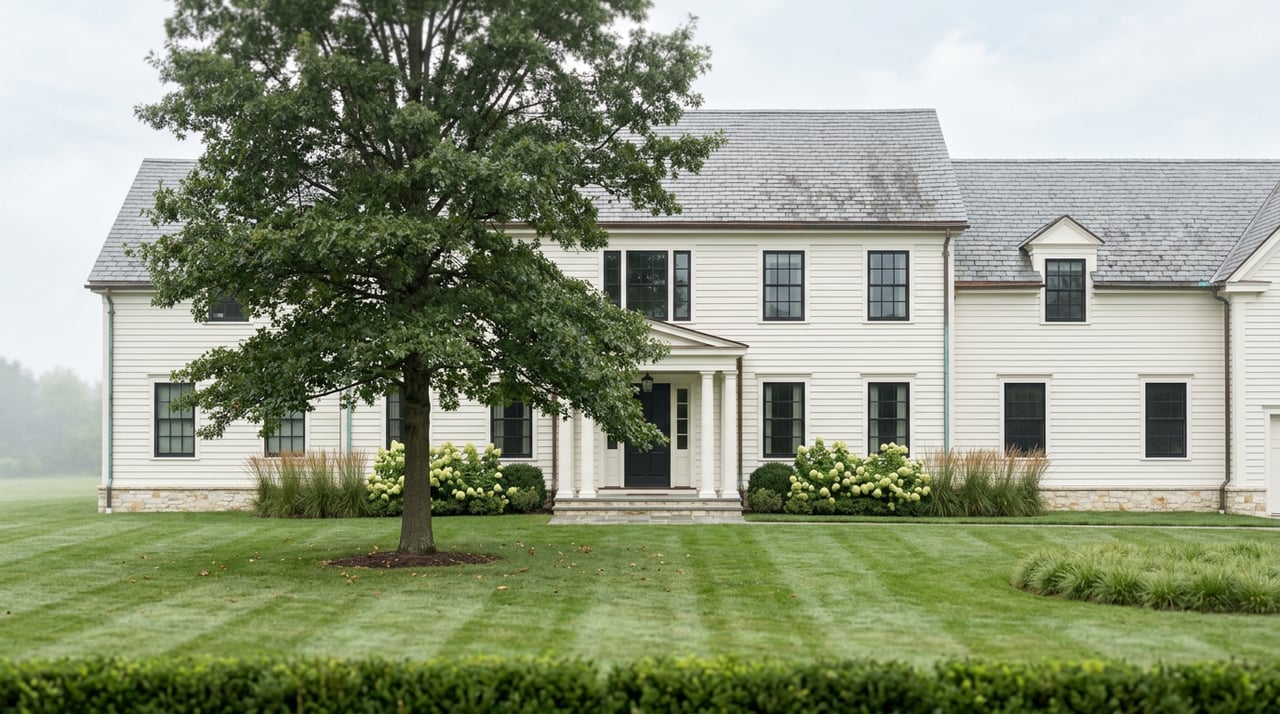
Drive down River Farm Lane on a Monday or Tuesday after 11 a.m. and you might pass a neighbor carrying a canvas bag of squash or tomatoes back to the car, timed to the farm's posted pickup hours. Ask most people in town what that address actually is and you get a shrug. From the road it looks like one more long driveway leading back toward another Saddle River estate.
It is not. It is a nineteen-acre working farm, with a horse barn, a state-approved manure management plan, and a vegetable operation with a documented history of selling out every season. The property is not a preserved relic kept alive by a conservation easement or a historical society. It is a private family's active business, built inside town limits, on purpose, in a borough where a single-family lot commands seven figures.
That contrast is the actual story. Saddle River markets itself, correctly, on its estates. But estates alone do not explain why a couple who could have built anywhere in Bergen County chose these specific nineteen acres for a horse operation and a working vegetable farm. The zoning did. And it is not the only property in town where that is true.
The Name Was Never Just Branding
Every version of the town's history repeats the same line: named for the river, and for the horse culture that grew up along it. Most towns treat that kind of etymology as trivia, printed on a welcome sign and otherwise irrelevant to daily life. Saddle River is one of the few towns in Bergen County where the name still describes something you can drive to and see functioning.
That is not an accident of geography. It is a byproduct of how the borough has zoned its land. The large-lot residential rules that protect the town's estate character also happen to preserve the acreage minimums that make horse boarding and small-scale agriculture possible in the first place. Shrink a town's typical lot down to a half acre, the way many neighboring suburbs have over the past several decades, and a twelve-stall barn with an indoor riding arena simply does not fit anywhere. Saddle River's zoning kept that option open even as the housing stock around it turned uniformly luxury.
Twelve Stalls, One Waitlist
Gary Schulze and Ann Marie Snyder found that out directly. The two met in 1998 volunteering on Ridgewood's Fourth of July committee, and by 2015 they were longtime Ridgewood residents looking for land with a specific brief: an equestrian facility for their teenage daughter, an accomplished competitive rider, and a vegetable garden for Gary, a recently retired general contractor who wanted to spend his newly free time farming instead of watching from the sidelines. They found both on the same nineteen acres in Saddle River, drawn in part by the borough's long history of horse-friendly land use.
The build reads like its own small construction project. B&D Builders, a barn specialist out of Lancaster County, Pennsylvania, designed and built the twelve-stall barn and its indoor riding arena. A Far Hills firm specializing in equestrian site design laid out the paddocks, the run-in sheds, and the circulation needed for horse trailers and fire trucks alike. Vintage Millwork and Restoration built the custom tack room, including a saddle island detailed enough to earn its own feature on a horse-property design site. The finished property, now operating as Patriot Farm, includes an eighty-by-two-hundred-foot indoor arena, a round pen, and a dozen grassy paddocks, alongside the family's own house, pool, and pool cabana.
The vegetable side started smaller and built its own following. Gary planted his first Community Supported Agriculture crop in the spring of 2016, on land that had a long prior history of agricultural use before the family bought it. A CSA works on a simple subscription model: neighbors buy a share before the growing season starts and pick up a box of whatever came off the farm that week, from acorn squash and bok choy to a dozen tomato varieties by midsummer. Patriot Farm has reported selling out its shares every season in the years after the program launched. That is not a curiosity. It means Saddle River residents have actually been eating vegetables grown a few minutes from their own driveways, not just admiring the idea of it from across town.
A Partnership the Town Doesn't Advertise
Patriot Farm is a private family operation, but it is not the only working equestrian facility with roots in the borough. Saddle River Equestrian, a seventy-stall training and boarding barn sitting on the state line between Bergen County and Rockland County, runs a formal partnership with Saddle River Day School. Students in the program get access to the facility's trainers and horses as part of an English equitation curriculum built around hunt seat and jumper disciplines, alongside a summer riding camp that runs four days a week through July and August for younger kids just starting out.
That partnership matters because it is structural, not incidental. A private school building an equestrian program directly into its offerings, rather than treating horses as an outside hobby families arrange on their own, tells you something about what this area's families expect to have access to close to home. It is the same underlying logic that explains why Patriot Farm's owners looked specifically at Saddle River instead of a dozen comparable towns nearby. The infrastructure for horses here is not vestigial. It gets used, by families, on a schedule.
What the Zoning Actually Protects
None of this means Saddle River is secretly rural. It is not. The estates are real, the acreage is priced accordingly, and most of the borough's daily rhythm has nothing to do with horses or squash. But the town's zoning has preserved something a lot of comparably wealthy suburbs gave up years ago: the physical room for large-scale private agriculture and equestrian use to exist alongside estate housing, rather than being priced or zoned out by it.
That distinction shows up in small, specific ways if you know where to look. A resident who wants land for a horse, or space to grow food at a scale beyond a backyard raised bed, has an actual local option in Saddle River that does not require a drive out to Sussex County or across the Delaware to find. Gary Schulze and Ann Marie Snyder did not need to leave Bergen County to get twelve stalls and a working farm built to their daughter's specifications. They needed to find the one borough left where the lot sizes and the local culture both still allowed it.
That is the part of the town's identity the estate photography does not usually capture. Saddle River is not preserving a memory of its agricultural past. It is still actively zoned for one, and at least two working properties are proving it right now.
If you are weighing what a piece of Saddle River acreage can actually support, from equestrian use to simple land preservation, Sheryl Epstein-Romano has spent decades working through exactly those questions with buyers and sellers in this market. Request a confidential consultation to talk through what your land allows.