
The stone house at Lake Street and East Saddle River Road is the oldest house in Upper Saddle River. Surveyor Charles Clinton recorded it in his journal in 1739, and it may be older. In her book on pre-Revolutionary Dutch houses, Rosalie Fellows Bailey wrote that a rough sheepskin map from about 1713 marks the site as the home of Gerrit Hoppa.
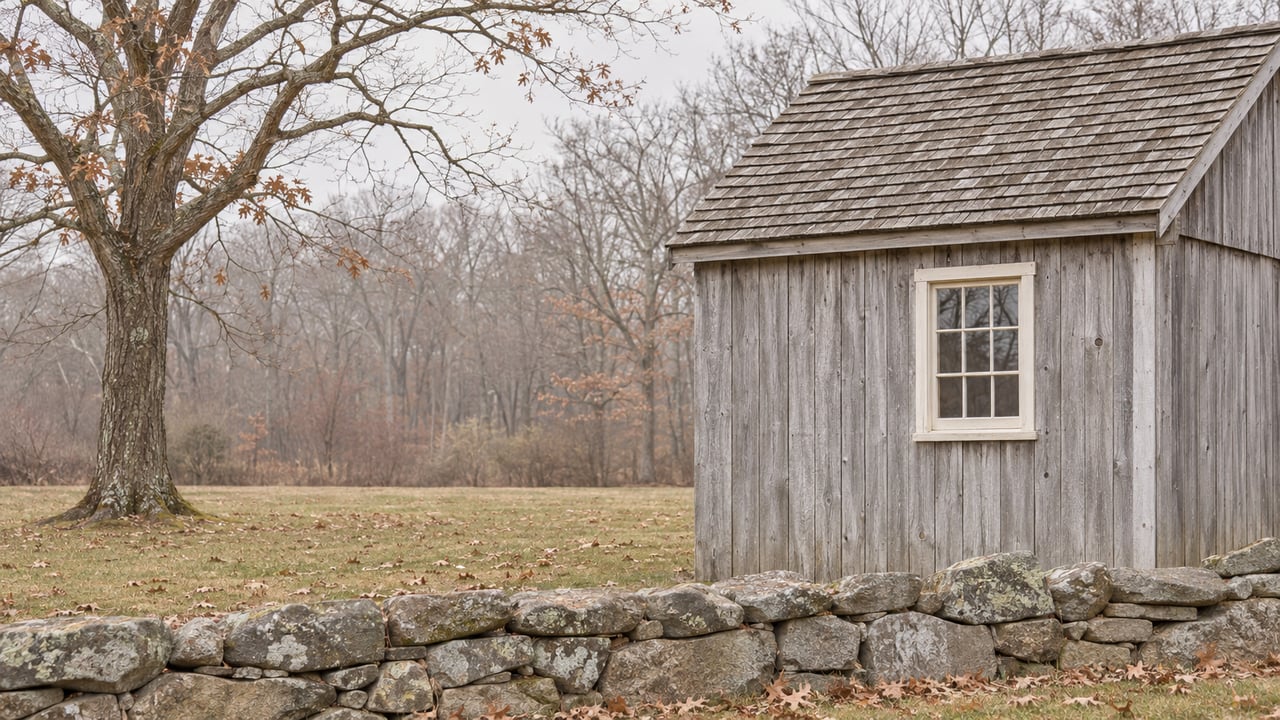
Behind the house is a small complex: a Dutch barn, a schoolhouse, a woodshed and a blacksmith shop. Most of these buildings started out somewhere else in town. One stood on West Saddle River Road and another on Lake Road. Others came from near the Ramsey border and from a farm at the opposite corner of Lake Street. Between 1989 and 2005 they were taken apart, carried over and rebuilt here, and the Upper Saddle River Historical Society paid for nearly all of it.
That makes the museum grounds a map of a town that has otherwise mostly vanished, folded into a single property on East Saddle River Road.
The deal that made the Society the owner of every repair
Clinton and Grace Carlough gave the house to the borough in 1985. Clinton was the nephew of Lizzie Goetschius, the last person to live there. The borough took it on one condition, which the borough's January/February 2026 Borough Bulletin still describes: the Historical Society had to sign a deed making it solely responsible for restoring and maintaining the house. The borough's part is to mow the lawn and plow.
When the Society signed, it had a little over $10,000. Residents joined as charter members, fundraisers were held, and local clubs helped clean up and restore the house. Since then the Society has raised several hundred thousand dollars. That money restored the house, the out kitchen and the privy, and it paid to move and restore the Dutch barn, ice house, woodshed and tenant house that now serves as the schoolhouse.
This arrangement explains how the grounds grew. Because the Society was responsible for every repair, it was also the group in a position to say yes when an old building elsewhere in town was about to be torn down.
Two buildings that never moved
Two buildings are original to the site, and the Society restored them before taking on anything else.
The out kitchen may be the oldest structure on the property and could be older than the house. It has a beehive oven, a jambless fireplace and a well. When the Society took over, the frame was falling apart and the fireplace wall was cracked. Claire Tholl, an Upper Saddle River resident and Bergen County historian, introduced the Society to George Turrell. He restored the frame in 1987, kept the east wall with its carvings by Steve Goetschius, and reused the original beams and as much of the old siding as he could.
The privy is a two-seater. It was used until 1962, when plumbing finally reached the house. Before then there was no running water, and the household carried water from the well and shoveled coal for heat.
The house was the town's working office for a long time too. Stephen Goetschius, great-great-grandson of the Rev. Stephen Goetschius of the Old Stone Church, served as borough clerk for more than 40 years and handled town business from the east room.
The barn that came down West Saddle River Road
The Hopper homestead once had several barns. In 1964 Lizzie Goetschius gave the rustic wood of her barn to the Greyhound exhibit at the World's Fair in New York. The barn was demolished and what was inside it was left in a pile, which was dug up in 1990 so a number of the items could be restored.
That left the farm without a barn. In 1988 Claire Tholl found a replacement. Wulster's barn on West Saddle River Road, just south of the Methodist Church, was scheduled to come down. She went inside and found that it had been built as a Dutch barn. By the Society's count, Bergen County had only five New World Dutch barns, including the Wortendyke Barn in Park Ridge and the barn inside Abma's farm store in Wyckoff.
The Van Riper family built the barn around 1800, and Harmon Tice owned it for many years after. In 1989 it was due to be demolished for a development. The developer offered to donate it if the Society removed it right away. Volunteers took the barn apart, moved it and rebuilt it in its original Dutch form. A photograph by Carmine Galasso of The Record shows Gregg Huber, Bill Yeomans and Bob Terry at the barn before it was dismantled. The barn was dedicated in 1990. Joe Sheffel supplied the lumber, and Mayor Frank Grout and the Carloughs attended.
The smaller buildings, and where each one stood
After the barn, the Society kept collecting smaller buildings over the next fifteen years.
Building | Where it stood | When it arrived | What it is now |
|---|---|---|---|
Van Riper-Tice Barn, c. 1800 | Wulster property, West Saddle River Road, south of the Methodist Church | Dismantled and moved after 1989; dedicated 1990 | Dutch barn on the museum grounds |
Ramsey-Sayer House, c. 1820 | Near the Ramsey border | 1999 | The museum's schoolhouse |
Woodshed | One-room school on West Saddle River Road, then a private home on Lake Road from 1952 | Moved and restored 2004–2005 | Restored woodshed |
Storage shed, c. 1850 | Terhune-Hopper farm, Lake Street and West Saddle River Road | Moved to the grounds | Blacksmith shop |
The Ramsey-Sayer House is the oldest frame house in Upper Saddle River. It measures 16 by 26 feet and is the kind of tenant house settlers of the Ramapo Tract built. The Society notes how rare it is to find a house that old that was never added onto or torn down. It also connects back to the main house. William Ramsey owned it in the 1850s, and his granddaughter Kate Fisher married George Goetschius and moved into the Goetschius house in the 1880s. While the house was being prepared for the move, workers found a late 19th-century advertisement for a clothing store chain inside it.
The woodshed moved twice. It first held wood and coal for the one-room school on West Saddle River Road, went to a private home on Lake Road in 1952, and reached the museum in 2004–2005.
The storage shed came from the Terhune-Hopper farm at Lake Street and West Saddle River Road. It was one of many outbuildings there, and it is the only one still standing. The Society now uses it as the blacksmith shop, where Gaspar Lesznik has demonstrated the trade.
What the grounds add up to
Taken together, these moves mean the grounds hold pieces of Upper Saddle River from up and down both of its main roads. The Hopper farm itself ran from the Saddle River at what is now Lions Park up the hill almost to Montvale. Today one corner lot holds a West Saddle River Road barn, a schoolhouse woodshed, a tenant house from the Ramsey line and the last outbuilding from a farm a short drive west.
The house's formal standing supports what the volunteers have done. New Jersey's Historic Preservation Office lists the house at 363 East Saddle River Road on the State Register as of October 3, 1980, and on the National Register as of January 10, 1983. Its National Register nomination includes it among the Early Stone Houses of Bergen County. The nomination describes a 1739 wing attributed to Abraham Hopper and a front of stucco over sandstone, painted to look like dressed stone, with real sandstone quoins at the corners.
The Society grew out of the 1976 Bicentennial. Kay and Bill Yeomans, Fred Hampton and Joan Fabris organized it in 1977. One hundred memberships came in almost immediately, and within a few years the count reached 500. The borough bulletin notes that 2027 will be the Society's 50th anniversary. The work is still paid for by members. Annual dues fund the restoration and upkeep of the museum, and members get free admission to museum events and four newsletters a year.
Seeing it in December
The Society's holiday open house is the time to see all the buildings in use at once. In the 2024 edition, Santa arrived by fire truck at 1:15 p.m. and sat in his sleigh in the Dutch barn. Chestnuts roasted in the out kitchen, the schoolhouse hosted a story and dreidel activity, and the house was open for holiday tours. According to the November/December 2025 Borough Bulletin, last year's event ran Sunday, December 7, from 1 to 4 p.m. This December's date will be on the Society's events page.
In summer, the Society runs Summer Sundays from 2 to 4 p.m. on Sundays in July and August, with tours and demonstrations. That two-hour window shapes the summer Sunday routine in Upper Saddle River we wrote about in July. The Society also offers a 360-degree virtual tour of the house, which works well before a first visit.
Anyone curious about how far the Carlough name reaches in town can read our post on the lake behind Carlough Road.
Upper Saddle River has many houses with long histories, and Sheryl Epstein-Romano has spent decades learning them, along with the borough's land-use and zoning history. If you own one of the town's older homes, or are weighing what its history means for a renovation or sale, we would be glad to talk. Request a confidential consultation.