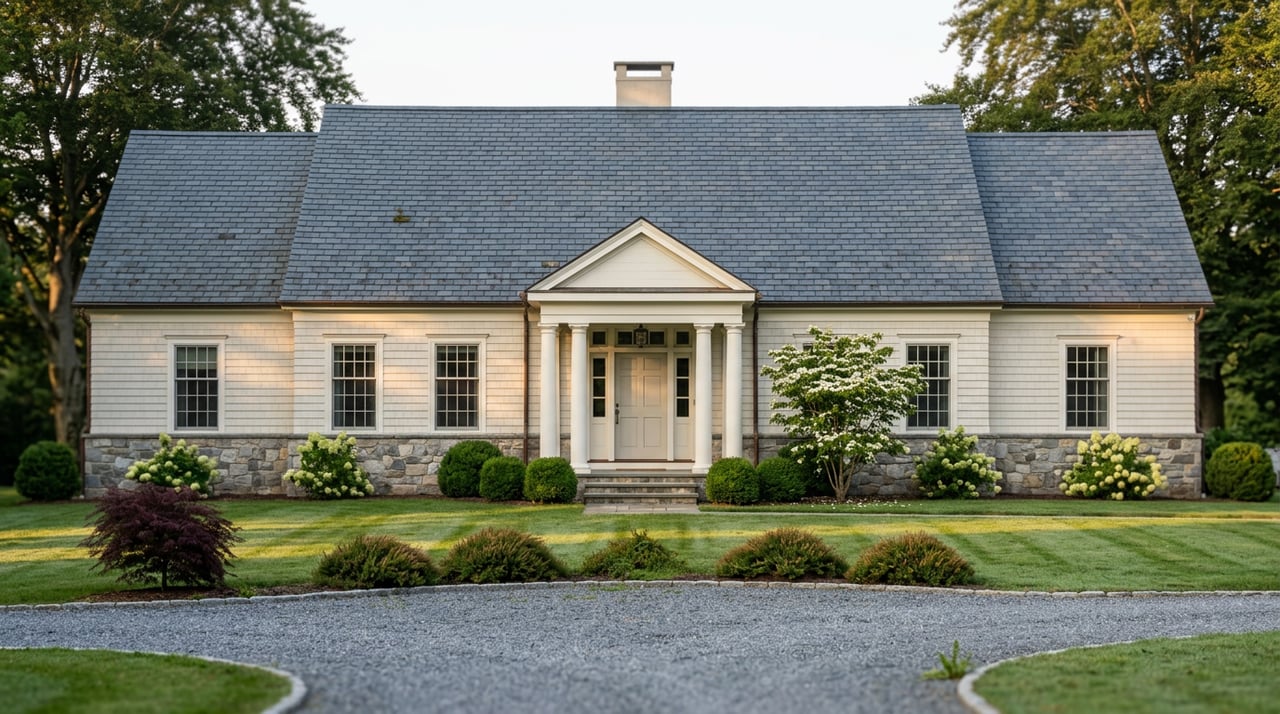
On August 14, 2026, a five-bedroom Hampton-style estate at 236 E. Saddle River Road closed for $4.75 million, about 22 percent over its $3.895 million asking price. Three days later, on August 17, a six-bedroom estate at 23 E. Denison Drive closed for $9.25 million, the highest price NJMLS has recorded for a New Jersey residential sale so far in 2026. Both properties sit on roughly the same amount of land, 2.15 acres and 2.1 acres. One sold for half what the other did.
If you have been watching Saddle River's numbers on a national home-value site while deciding whether to buy or sell here, this is the week that should make you stop trusting the headline figure. Not because the number is fake. Because a town this small cannot generate a stable median, and the two sales above are the clearest proof available right now.
A Town With Almost No Data to Average
Saddle River has roughly 1,500 housing units. Do the arithmetic and you get a market that turns over about 2.5 percent of its housing stock in a year.
That is not a market. That is a handful of transactions large enough to move a statistic by hundreds of thousands of dollars depending on which two or three houses happen to close in a given month. In a town like this, a single $9.25 million closing does not describe the market. It distorts it, at least until the next thirty-some sales dilute the effect.
This is the part most portal-driven house hunting skips past. A median is a snapshot of whoever happened to close, not a measurement of where values are heading. When the sample size drops into the dozens, the snapshot stops representing anything reliable.
Why the Numbers You've Already Seen Don't Agree
If you have compared Saddle River listings across more than one site recently, you likely noticed the figures don't line up. One national home-value platform reported a median sale price of $2.7 million in January 2026, up 56 percent from a year earlier, while quoting a median price per square foot of $485, down more than 6 percent over the same period. Another aggregator put the median asking price at $2.35 million in June 2026, with price per square foot down 42 percent year over year. A third source listed a median sale price of $2.5 million, up 11 percent annually, alongside a separate median calculation near $2.76 million.
Four numbers, four different stories, and none of them agree on what happened in the same town within the same year.
The contradiction is not a data error. It is what happens when a rising median and a falling price-per-square-foot show up in the same report. That combination usually means the mix of homes that closed shifted, not that per-square-foot value changed. A few larger, higher-end estates closing in a given period pull the median sale price up even as the per-square-foot rate, spread across a wider range of home sizes, moves in the opposite direction. Saddle River, with its concentration of estate-scale properties and thin transaction count, is exactly the kind of market where this mismatch shows up loudly and often.
What Two Nearly Identical Lots Actually Tell You
236 E. Saddle River Road | 23 E. Denison Drive | |
|---|---|---|
Closed | Aug. 14, 2026 | Aug. 17, 2026 |
Sale price | $4.75 million | $9.25 million |
Lot size | 2.15 acres | 2.1 acres |
Bed / bath | 5 bed, 7 full, 1 half | 6 bed, 8 full, 2 half |
Both lots clear Saddle River's roughly two-acre zoning minimum, a standard the borough adopted in 1951 to preserve low density and has held to since. That single fact is exactly why comparing these two sales is useful: once a property is above that acreage floor, the land itself stops explaining the price gap. Something else does.
The Saddle River Road property is a 2017 build with a heated gunite pool, a golf simulator room, and a primary suite with a steam shower. It last traded in October 2020 for $3.55 million, then found seven offers within days of a relaunch built around social video and professional photography, according to the same Daily Voice report on the sale. The Denison Drive estate carries a different kind of premium: its architecture is by Jordan Rosenberg, construction by Park Hill Development, and interiors by Vanessa DeLeon Associates, a pedigree that places it in a different tier of buyer consideration entirely.
Neither home is more or less "Saddle River" than the other. But if you were trying to price a listing or evaluate an offer using price per acre or price per square foot as your primary tool, these two closings would tell you almost nothing useful. The variable driving the $4.5 million gap is design, construction quality, and market positioning, not lot size and not raw square footage.
What This Means If You Are Actually Pricing a Home Here
If you are selling in Saddle River, resist the instinct to anchor your number to whatever median you last saw online. With this few transactions, that figure could easily reflect a single unrelated closing three towns over in the same MLS pull, or a temporary skew toward larger estates. What holds up better is a close read of the two or three most recent closings in your specific acreage and quality tier, the kind of comparison that requires someone tracking these individual sales as they happen rather than waiting for a monthly aggregate to update.
If you are buying, the same logic protects you from overpaying or underbidding based on a headline number that may not describe the segment of the market you are actually shopping in. A $2.7 million median tells you almost nothing about what a 2017 Hampton-style build on 2 acres is worth versus an architect-designed estate with a name-brand construction and interiors team on the same acreage. Those are two different products competing in the same zip code, priced by two different sets of buyers.
Appraisers face this exact problem when there are only a handful of truly comparable closings within the last twelve months. The stronger the documentation you can bring to that process, permits, upgrade records, the design and build team behind the work, the better positioned you are when a formal appraisal has to make sense of a market this thin.
Frequently Asked Questions
If Saddle River only has a few dozen closings a year, how can I know what my home is worth? Lean on the most recent comparable sales in your specific acreage and quality tier rather than a town-wide median. With this few transactions, a single unrelated closing can shift the aggregate number without reflecting anything about your property.
Does a rising median mean home values in Saddle River are going up? Not necessarily. A rising median paired with a falling price per square foot, which is what national platforms showed for Saddle River at different points across the first half of 2026, usually signals that the mix of homes selling has shifted toward larger or higher-end properties, not that value per square foot has actually increased.
Why did two homes on nearly identical lot sizes sell for such different prices in the same week? Once a property clears the borough's roughly two-acre zoning minimum, land size stops being the primary driver of price. Construction quality, design pedigree, and how a property is positioned to buyers explain gaps like the one between these two August closings far more than acreage does.
Saddle River's numbers reward someone who is watching the actual closings, not just the aggregate. If you are trying to price a sale or evaluate what a listing is really worth in a market this thin, Sheryl Epstein-Romano can walk you through the comparable sales that matter for your specific property. Request a confidential consultation to start that conversation.